
Peter Tumbas
REALTOR® · Berkshire Hathaway HomeServices New England Properties
- Manhattan's median sale price held at a record $1.25 million in the third quarter of 2026, up 5.9% from a year earlier, while active listings fell 10.7%.
- Upper East Side buyers face fewer choices, and new development there closed at a 0% discount. Line up financing and board documents before touring.
Manhattan buyers had fewer apartments to choose from this summer, and they paid record prices for the ones they found. Third-quarter 2026 reports released on October 2 show closed sales up, active listings down and the median price holding at its high. This guide walks through the numbers and explains what they mean if you are shopping on the Upper East Side. Figures are as of October 4, 2026.
What happened in the Manhattan housing market in the third quarter of 2026?
The Manhattan median sales price for co-ops and condos stayed at the record $1.25 million set in the second quarter, up 5.9% from a year earlier, according to the quarterly market report from appraisal firm Miller Samuel and The Real Deal. Closed sales rose 8% from the third quarter of 2025, the seventh increase in eight quarters, Brick Underground reported.
Supply moved the other way. Active listings fell 10.7% from a year earlier, another year-over-year decline. Fewer apartments competing for more buyers is the reason prices stay at the top of the range.
How did luxury homes and townhouses perform?
The luxury segment, defined as the top 10% of Manhattan sales, had a median price of $5.917 million, essentially flat from last year. Luxury listings fell 14.1%, so the buyers who can afford those homes have fewer to pick from.
Townhouses behaved differently. The average townhouse price dropped 18.6% to $6,331,987, the lowest level in more than a year, per the same Miller Samuel and The Real Deal data. Townhouse averages swing with a small number of sales. The Upper East Side has more townhouse blocks than most Manhattan neighborhoods, so this segment is worth watching if you want a house.
Which price range is growing fastest?
Two- and three-bedroom apartments priced between $2 million and $5 million posted the strongest price growth, according to Jonathan Miller, author of the report. That range sits just below the luxury threshold. It is the range where larger, family-size apartments sit on the Upper East Side, so buyers shopping for space feel the shortage most.
How did the Upper East Side compare with other Manhattan submarkets?
New development data for the third quarter breaks Manhattan into eight submarkets. The Upper East Side recorded 39 new development closings, 9.8% of the Manhattan total, and closed them at a 0% discount. It also had 51 active new development listings, a 9.0% share. Downtown led with 113 closings and Midtown East followed with 109.
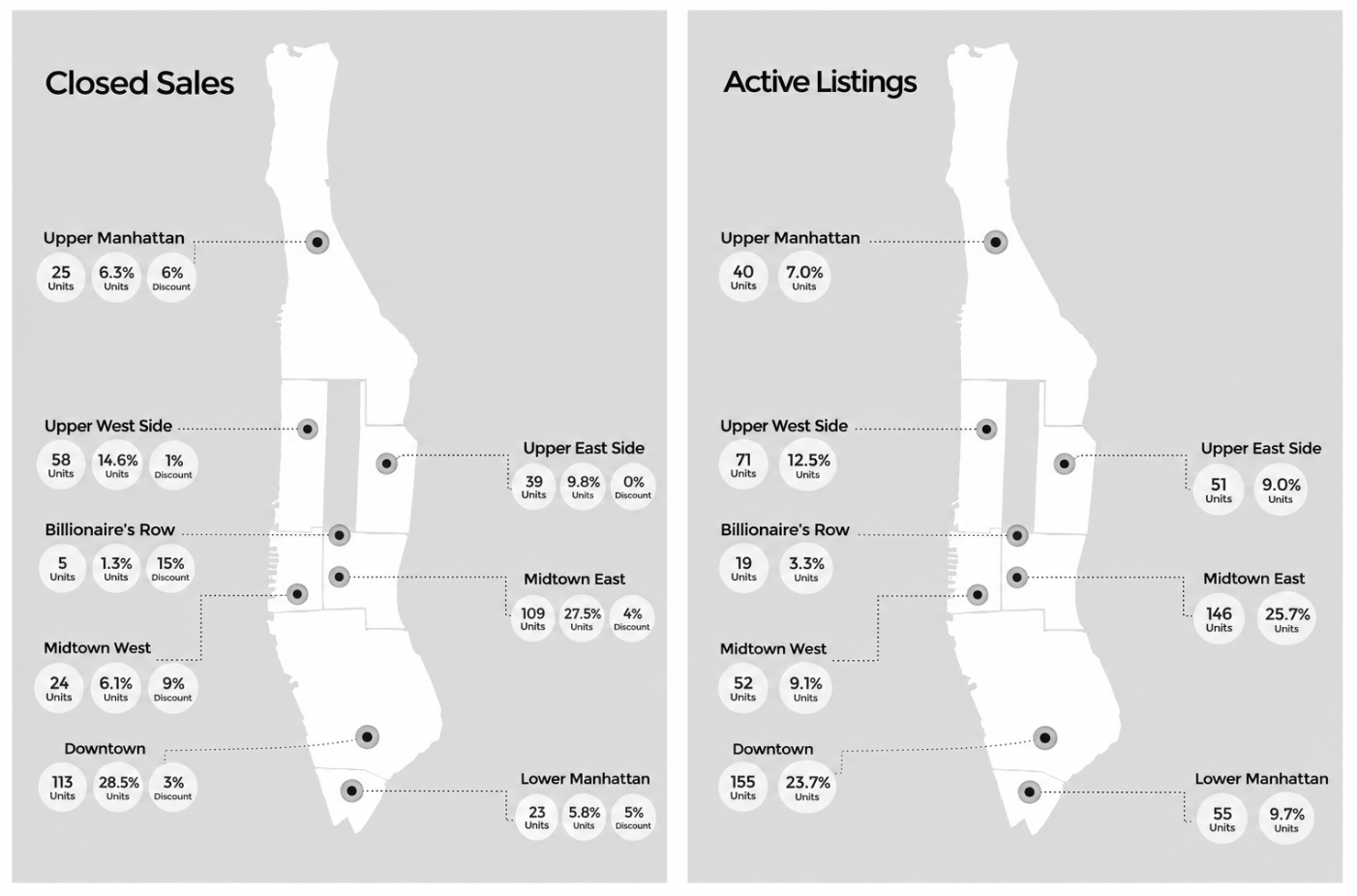
A 0% discount means new development buyers on the Upper East Side had almost no room to negotiate. Other submarkets gave more: the discount at closing reached 15% on Billionaire's Row and 9% in Midtown West.
Source: Q3 2026 new development closed-sales data by Manhattan submarket, shown in the graphic above. Data as of October 4, 2026. Covers new development only, not resale co-ops and condos.
These figures cover new development only. Most Upper East Side homes are resale co-ops and condos, which follow the broader market trends above. For a deeper look at how the two building types differ, read our guide to co-op or condo on the Upper East Side.
What do higher mortgage rates mean for buyers?
The 30-year fixed mortgage rate averaged 7.28% on October 1, 2026, according to Freddie Mac. That is up from 7.03% the week before and 6.34% a year earlier. The 15-year rate averaged 6.60%.
A higher rate raises the monthly payment on any financed purchase, which matters most in Manhattan because prices are high. Co-op buyers also face board financial reviews, so a larger loan tightens the debt-to-income picture the board evaluates. Run your numbers at today's rate, not last year's.
What should Upper East Side buyers do now?
- Get fully pre-approved before you tour. With fewer listings, the apartments that fit your budget sell to buyers who can move fast. Ask your lender for a letter that reflects today's rate.
- Assemble your board package early. A complete package submitted within days of signing a contract keeps a co-op purchase on schedule. Our guide to the co-op board package lists what to gather.
- Budget for the full cost of buying. Closing costs run about 2% to 5% of the price. See what it costs to buy on the Upper East Side in 2026.
- Know your neighborhood before you offer. Prices and building types differ across Lenox Hill, Carnegie Hill and Yorkville. Our guide to Yorkville versus Carnegie Hill compares two of them.
- Work with a licensed New York agent. Peter introduces buyers to vetted agents who work Upper East Side purchases regularly and know the buildings.
General information only, not legal or financial advice. Market figures come from third-party reports and change quarterly. Confirm current numbers with your New York agent.
Frequently asked questions
How much did Manhattan home prices rise in the third quarter of 2026?
The median sales price for Manhattan co-ops and condos was $1.25 million in the third quarter of 2026, a record that matched the second quarter and sat 5.9% above a year earlier. The luxury median, covering the top 10% of sales, was $5.917 million and essentially flat from last year. Closed sales rose 8% from the third quarter of 2025.
Is Manhattan inventory low in 2026?
Yes. Active listings fell 10.7% from a year earlier in the third quarter of 2026, and luxury listings fell 14.1%. Fewer homes for sale means more competition for each one, especially in the $2 million to $5 million range where two- and three-bedroom apartments posted the strongest price growth.
Can you negotiate on a new development condo on the Upper East Side?
Little room existed in the third quarter of 2026. New development closings on the Upper East Side came at a 0% discount, compared with 15% on Billionaire's Row, 9% in Midtown West and 5% in Lower Manhattan. Resale co-ops and condos negotiate differently, so ask your agent for recent comparable sales in the building. See also: Co-op or Condo on the Upper East Side.
What are mortgage rates for a Manhattan apartment in October 2026?
The 30-year fixed rate averaged 7.28% on October 1, 2026, according to Freddie Mac, up from 6.34% a year earlier. Rates change weekly and your quote depends on your down payment, credit and loan size. Get a current pre-approval before you tour, and run payment estimates at today's rate. See also: What It Costs to Buy on the Upper East Side in 2026.
How should Upper East Side buyers prepare for a tight market?
Get fully pre-approved, line up a New York real estate attorney and assemble your co-op board package before you start touring. Sellers favor buyers who can sign quickly and close without delay. A complete board package submitted within days of signing keeps a purchase on schedule. See also: The Co-op Board Package.
Which Upper East Side neighborhood has the most variety of homes?
Yorkville has the widest mix of building types, from pre-war walk-ups to full-service condo towers, and often offers more space for the money than blocks west of Lexington Avenue. Carnegie Hill leans toward pre-war co-ops and townhouses, and Lenox Hill holds the grand Park and Madison Avenue co-ops. See also: Yorkville vs. Carnegie Hill.
Sources
Ready to look on the Upper East Side?
Peter is a Connecticut-licensed REALTOR® who introduces buyers to licensed New York agents. Tell him your budget and building type and he will match you with the right one.
October 2026
Yorkville vs. Carnegie Hill: Which Upper East Side Neighborhood Fits?
Two very different ways to live on the Upper East Side, and the questions that decide between them.
Read →October 2026
Co-op or Condo on the Upper East Side: How to Choose
What you actually own, how approval and financing differ, and which buyers each structure suits.
Read →October 2026
What Goes Into a Co-op Board Package
The documents co-op boards ask for, how the review works, and how to prepare before you make an offer.
Read →October 3, 2026
How Much Does It Cost to Buy an Apartment on the Upper East Side in 2026? Price, Closing Costs, Taxes and Monthly Fees
Upper East Side prices, buyer closing costs, the mansion tax, monthly charges and the new pied-à-terre surcharge for co-op and condo purchases, with 2026 figures.
Read →