
Peter Tumbas
REALTOR® · Berkshire Hathaway HomeServices New England Properties
- "Newly renovated" tells you the finishes are recent, not that the board approved the work. In a co-op, owners generally sign an alteration agreement and maintain the altered work, and buyers may be asked to sign an assumption agreement. Ask for the approval, the agreement and any permit records before you offer.
- On a $319,000 studio with 20% down, cash to close is about $70,180 and principal and interest is about $1,746 a month at 7.28%. Maintenance is extra, at an assumed $700 to $1,000. Check the sublet rules too, since co-ops often limit renting.
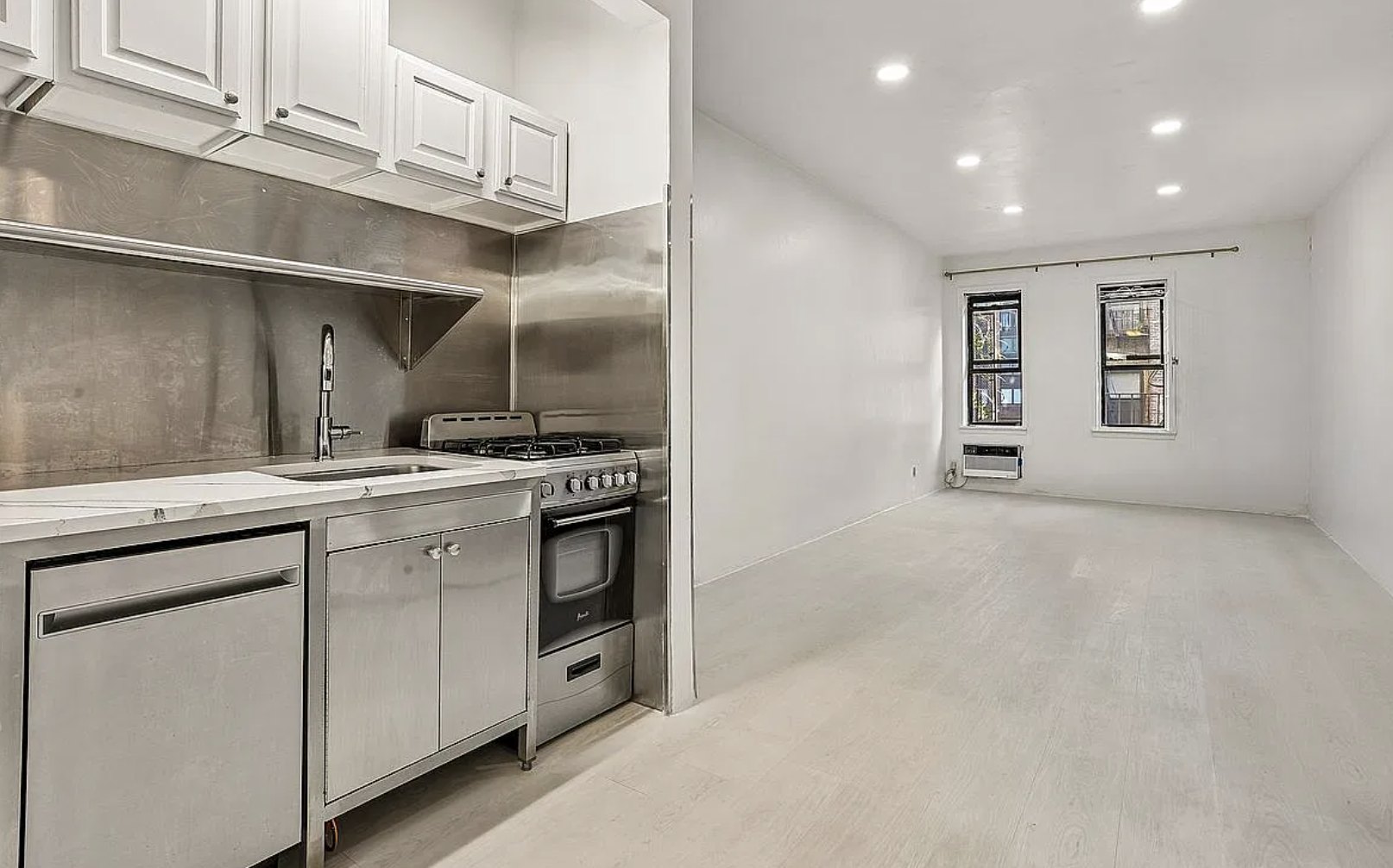
"Newly renovated" is the most persuasive phrase in a small-apartment listing, and it deserves a few questions. The studio pictured, in Yorkville, asks $319,000 and shows a stainless steel kitchen with a gas range and dishwasher, recessed lighting and fresh floors. In a co-op the work was done under rules set by the building, and you will inherit its paperwork along with the apartment. This guide explains what to check, then runs the monthly cost, cash to close, board tests and sublet rules. We do not know this apartment's building, maintenance or approvals, so the figures use stated assumptions. Figures are as of October 25, 2026.
What does "newly renovated" tell you, and what does it not?
It tells you the finishes are recent. It does not tell you whether the board approved the work, whether permits were needed and closed out, or whether the work was done well. Habitat magazine says co-ops generally require owners to get board approval and sign an alteration agreement, and that after it is signed the owner, not the board, handles maintenance and repair of the altered work. That is why the paperwork on someone else's renovation matters to you.
Habitat adds that a future owner may not know about earlier alterations, that buyers should be required to sign an assumption agreement before or at closing, and that sellers are unlikely to raise it. Whether this applies depends on the building and its documents, so ask your attorney. Our renovation guide explains what an alteration agreement contains and how approval works.
What should you ask for before you offer?
Habitat's guidance sets out why the paperwork matters. The list below is our suggested starting point, not a legal checklist, so have a New York attorney tell you what to request for this building.
| Request | Why |
|---|---|
| Alteration agreement and board approval | Shows the building approved the work and the terms that now bind the unit |
| Assumption agreement | Habitat says buyers may have to take on prior owners' alteration obligations |
| Scope of work | Tells you what was changed, such as the kitchen, plumbing or electrical |
| Department of Buildings records | If the work required permits, ask your attorney to confirm they were obtained and closed |
| Building rules on appliances | The photo shows a gas range, a dishwasher and a window air conditioner. Ask whether the lease, rules or agreement address them |
Also look at the work in person. Run the water and the appliances, check under the sink and look at the ceiling in the unit below if you can. Fresh paint and floors can hide old problems. Our financial statements guide covers the building side, including reserves, assessments and the underlying mortgage.
What does a $319,000 studio cost each month?
The table assumes 20% down ($63,800), a loan of $255,200 and a 30-year fixed rate of 7.28%, the average in our rates guide. Principal and interest is about $1,746 a month. Our maintenance guide cites about $1.40 to $2.00 per square foot for Upper East Side co-ops, which on an assumed 500-square-foot studio is $700 to $1,000. The apartment's real size and charge will differ.
| Maintenance | Monthly total | Income at 30% | 12 months | 24 months |
|---|---|---|---|---|
| $700 ($1.40/sq ft) | $2,446 | $97,840 | $29,352 | $58,704 |
| $850 ($1.70/sq ft) | $2,596 | $103,840 | $31,152 | $62,304 |
| $1,000 ($2.00/sq ft) | $2,746 | $109,840 | $32,952 | $65,904 |
Maintenance is assumed at $1.40, $1.70 and $2.00 per square foot for a 500-square-foot studio. Illustration, not a quote. Data as of October 25, 2026.
Maintenance in a co-op includes the building's property tax. "Income at 30%" is the yearly income at which the monthly total is 30% of income, in the 25% to 30% debt-to-income range boards commonly use, per our down payment guide. The last two columns are 12 and 24 months of the monthly total, the reserve range that guide reports. Totals exclude electricity, insurance and any special assessment.
How much cash do you need to close?
The table uses 2% of the price for closing costs, the planning figure in our down payment guide. Actual costs depend on the lender, attorneys and building fees. The mansion tax starts at $1 million, so it does not apply here.
| Item | 20% down | 25% down |
|---|---|---|
| Down payment | $63,800 | $79,750 |
| Closing costs (2%) | $6,380 | $6,380 |
| Cash to close | $70,180 | $86,130 |
| Loan | $255,200 | $239,250 |
| Principal and interest a month | $1,746 | $1,637 |
These amounts exclude board-required reserves. First-time buyers may qualify for help with the down payment, which our under-$500,000 guide covers. Our closing guide shows when each dollar is due.
Can you rent out a studio co-op?
Studios attract buyers who may want to rent them out, and co-ops limit that. Skybriz, in a January 27, 2026 guide, reports these common patterns. Other buildings differ.
| Rule | Common pattern |
|---|---|
| Live there first | Often 2 years; 3 in some premium Manhattan buildings |
| How long you can sublet | Most commonly 2 years out of every 5 |
| Minimum lease | Usually one year |
| Monthly surcharge | Commonly 25% to 30% of maintenance |
| One-time fees | Application $500 to $2,000; move-in $500 to $1,500 |
| Approval | Board review, generally 30 to 60 days; the board can accept or reject largely at its discretion |
On the $850 middle maintenance case, a 25% to 30% surcharge would add $212 to $255 a month, plus the one-time fees. Skybriz says buyers who may need to sublet should consider condos, which usually cost more, and our co-op or condo guide compares them. Get the sublet policy for this building in writing.
What about resale?
Plan your exit when you buy. Co-op sellers may owe a flip tax, which commonly runs 1% to 3% of the price when a building charges one, per our cost guide. On a $319,000 sale that would be $3,190 to $9,570. See our net proceeds guide for the other seller costs. Limits on subletting also narrow the pool of buyers, which is our reading rather than a statistic.
How do you start?
Tell us your budget, your down payment and whether the studio will be your primary home. We match you with a licensed New York agent who works Yorkville, Carnegie Hill or Lenox Hill, plus a lender and attorney who handle co-ops. Submit a private inquiry below.
General information only, not legal, tax or financial advice. Rates, rules and costs change and each building differs. The photo shows a Yorkville studio listed at $319,000; we have not verified its building details or renovation history, and listings can change or sell. The worked examples are illustrations with stated assumptions, not quotes. Peter is licensed in Connecticut and does not represent buyers in New York. Confirm every step with your New York attorney and lender.
Frequently asked questions
What does "newly renovated" mean in a co-op listing?
It tells you the work is recent, not that the building approved it or that it was done well. In a co-op, owners generally need board approval and a signed alteration agreement for renovations, and the work is governed by that agreement. Ask the managing agent and your attorney to confirm the paperwork for the work you can see. See also: Renovating an Upper East Side Co-op.
Who is responsible for the previous owner's renovation?
In a co-op, after an alteration agreement is signed the owner, not the board, handles maintenance and repair of the altered work, according to Habitat magazine. Habitat also says buyers may be required to sign an assumption agreement taking on the prior owners' alteration obligations, and that sellers are unlikely to mention it. Ask your attorney whether one applies.
What documents should you ask for on a renovated co-op?
Ask for the alteration agreement and board approval for the work, any assumption agreement the building requires, and, if the work needed Department of Buildings permits, the permit and sign-off records. Ask your attorney what else to request.
How much does a $319,000 studio co-op cost per month?
With 20% down and a 30-year fixed rate of 7.28%, principal and interest is about $1,746 on a $255,200 loan. Maintenance depends on the building. At an assumed $700 to $1,000 the monthly total is about $2,446 to $2,746, before electricity, insurance and any assessment. See also: Maintenance, Common Charges and Hidden Fees.
How much cash do you need to buy a $319,000 studio?
At 20% down, about $70,180: the $63,800 down payment plus closing costs of about $6,380 at a 2% planning figure. The mansion tax does not apply below $1 million. Many boards also want 12 to 24 months of mortgage and maintenance in liquid reserves after closing. See also: Buying on the Upper East Side Under $500,000.
Can you rent out a studio co-op?
Often only for a limited time. Skybriz reports that shareholders commonly must live in the unit for about two years before subletting, and the most common cap is two years out of every five, with a monthly surcharge commonly 25% to 30% of maintenance. Rules differ by building, so get the policy in writing before you buy. See also: Co-op or Condo on the Upper East Side.
Sources
Buying in Yorkville?
Peter is a Connecticut-licensed REALTOR® who introduces buyers to licensed New York agents. Tell him your budget and building type and he will match you with the right one.
October 2026
Yorkville vs. Carnegie Hill: Which Upper East Side Neighborhood Fits?
Two very different ways to live on the Upper East Side, and the questions that decide between them.
Read →October 2026
Co-op or Condo on the Upper East Side: How to Choose
What you actually own, how approval and financing differ, and which buyers each structure suits.
Read →October 2026
What Goes Into a Co-op Board Package
The documents co-op boards ask for, how the review works, and how to prepare before you make an offer.
Read →October 3, 2026
How Much Does It Cost to Buy an Apartment on the Upper East Side in 2026? Price, Closing Costs, Taxes and Monthly Fees
Upper East Side prices, buyer closing costs, the mansion tax, monthly charges and the new pied-à-terre surcharge for co-op and condo purchases, with 2026 figures.
Read →October 4, 2026
Manhattan Sales Rise as Inventory Shrinks: What the Third Quarter 2026 Numbers Mean for Upper East Side Buyers
Manhattan closed sales rose 8% and listings fell 10.7% in the third quarter of 2026 while the median price held at a record $1.25 million. What it means for Upper East Side buyers.
Read →October 5, 2026
Rent vs. Buy on the Upper East Side in 2026: When Does Owning Beat Renting?
A $4,500 rent costs $54,000 a year. See what ten years of renting and owning cost on the Upper East Side and when owning breaks even at 2026 rents and mortgage rates.
Read →October 6, 2026
Will Upper East Side Prices Fall to Offset 7% Mortgage Rates? What Buyers and Sellers Should Do
Prices would have to fall 41% to offset a 7.28% mortgage rate against the 2021 low. Practical moves for Upper East Side buyers and sellers in the 2026 market.
Read →October 7, 2026
How to Buy an Apartment on the Upper East Side as an Out-of-State Buyer: A Step-by-Step Guide for 2026
The steps, deposit, timeline and costs to buy an Upper East Side apartment if you live outside New York, from preapproval and attorney to board approval and closing.
Read →October 8, 2026
Buying a Pied-à-Terre on the Upper East Side in 2026: A Checklist to Run Before You Make an Offer
Co-op rules, the new NYC pied-à-terre surcharge, New York tax residency, second-home financing and rental limits: eight checks to run before you buy a part-time apartment on the Upper East Side.
Read →October 9, 2026
Upper East Side Maintenance, Common Charges and Hidden Fees in 2026: What You Pay Every Month After You Buy
What co-op maintenance and condo common charges cover, what they leave out, typical Upper East Side ranges, and how to spot special assessments before you buy.
Read →October 13, 2026
How to Read a Co-op's Financial Statements Before You Offer: The 10 Numbers Upper East Side Buyers Should Check
Reserves, underlying mortgage, arrears, sponsor-owned units, assessments and audit notes: what each number means, what to look for and the red flags in a co-op building's finances.
Read →October 14, 2026
Manhattan Rents Are Up 7.7% While Rental Listings Shrink: Why Some Upper East Side Renters Should Run the Numbers on Buying
Manhattan median rent is $4,900 and rental listings have fallen 15 months in a row. What the September 2026 rental report shows, what it does not, and when buying is worth a serious look.
Read →October 15, 2026
How Much Down Do You Need for an Upper East Side Co-op? Down Payment, Debt-to-Income and Cash Reserve Rules Explained
Most Upper East Side co-op boards look at three numbers: your down payment, your debt-to-income ratio and the cash you keep after closing. Typical ranges, what counts, and a worked example on a $329,000 one-bedroom.
Read →October 16, 2026
How Much Will You Net Selling an Upper East Side Co-op? Transfer Taxes, Flip Tax, Commission and Closing Costs Explained
What a $1,595,000 Upper East Side sale leaves in your pocket: transfer taxes, flip tax, commission, attorney and building fees, a worked net proceeds table and the tax on your gain.
Read →October 18, 2026
Why Upper East Side Apartments Are Priced at $999,000: How the $1 Million Mansion Tax Line Changes Your Offer
A $999,000 asking price sits $1,000 under the $1 million mansion tax line. What a $1,000,000 bid really costs, the cash needed on a $999,000 two-bedroom, and how buyers and sellers should offer and price.
Read →October 19, 2026
What Happens at an Upper East Side Co-op Board Interview? Questions, Timeline and How to Prepare in 2026
What a co-op board interview is, the questions boards ask, how long approval takes, what a board can and cannot legally do, and a worked number check on a $525,000 one-bedroom.
Read →October 20, 2026
Local Law 11 Façade Inspections and Special Assessments: What Upper East Side Co-op Buyers Should Check Before They Offer in 2026
What NYC's façade inspection law means for a co-op buyer: Safe, SWARMP and Unsafe reports, sidewalk shed rules, how a special assessment could hit your share, and what to ask before you offer.
Read →October 21, 2026
Can You Renovate an Upper East Side Co-op? Alteration Agreements, Board Approval, Costs and Timelines in 2026
What an alteration agreement is, what a board needs before you renovate, the fees and timeline before work starts, what renovation costs per square foot, and what to check before you offer.
Read →October 22, 2026
What Happens at a Co-op Closing in Manhattan? Documents, Cash Due, Timeline and a Closing-Day Checklist for 2026
The documents, cash due, timeline and closing-day checklist for a Manhattan co-op purchase, with a worked example on a $675,000 Yorkville one-bedroom.
Read →October 23, 2026
Buying a $1.375 Million Upper East Side Co-op: Is It a Jumbo Loan? Down Payment, Mansion Tax and Cash Needed in 2026
Whether a $1.375 million co-op loan is a jumbo, plus the down payment, $13,750 mansion tax, cash to close and monthly cost, with a worked example on a Yorkville two-bedroom.
Read →October 12, 2026
How to Buy an Apartment Under $500,000 on the Upper East Side in 2026: What You Get, What to Check and the Catches
Three real Upper East Side listings under $500,000, what they cost each month, how much cash you need, first-time buyer loan programs and the co-op catches to check before you offer.
Read →October 28, 2026
Buying a Ground-Lease Co-op in Lenox Hill: Lease Expiration, Rent Resets, Financing and What to Ask Before You Offer in 2026
How a ground-lease co-op works, why the rent reset and lease expiration matter, a real Lenox Hill listing, and cash to close at $1.195 million, with the questions to ask before you offer.
Read →October 29, 2026
How to Make an Offer on an Upper East Side Apartment: Bidding, the Contract, the 10% Deposit and the New 45-Day Co-op Board Clock in 2026
What an offer includes, how negotiation and the contract work, the 10% deposit, contingencies and the new 45-day co-op board clock, with a worked example on a $549,000 Yorkville one-bedroom.
Read →