
Peter Tumbas
REALTOR® · Berkshire Hathaway HomeServices New England Properties
- You can renovate a co-op apartment, but only with the board's approval under an alteration agreement. Expect 2 to 4 months before work starts (3 to 8 weeks of that is board review), $10,000 or more in fees and deposits, and a 90 to 120 day window to finish, with weekday-only work hours.
- One 2026 cost guide puts renovations at $150 to $250 per square foot for a cosmetic refresh, $250 to $450 for a full renovation and $500 or more for a high-end gut, plus 15% to 25% for fees and permits. Ask for the building's alteration policy before you offer, since it controls floors, plumbing, windows and hours.
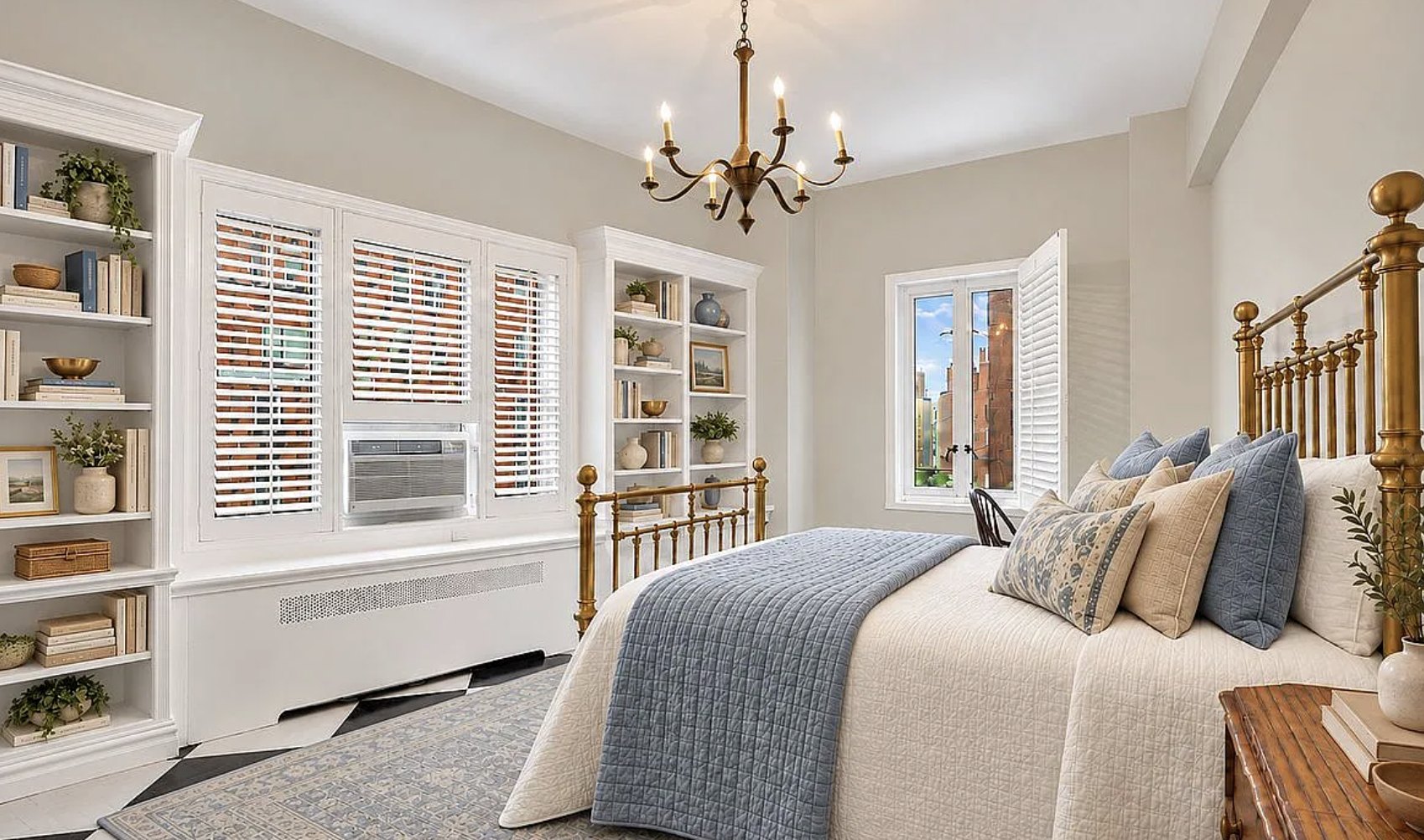
In a co-op you own shares and a proprietary lease, not the walls, and the board controls what you can change inside your apartment. That matters on the Upper East Side, where many buyers plan to update a kitchen, a bathroom or the floors after closing. A bedroom like the one pictured, with built-in shelving and shuttered windows, is the kind of space buyers imagine refreshing. This guide explains the alteration agreement, what boards require, the fees and timeline before work starts, what renovations cost and the building rules to check before you offer. Figures are as of October 21, 2026, and costs vary widely by building and scope.
What is an alteration agreement?
An alteration agreement is the legal document that governs a renovation in a co-op or condo. It sets the scope of work, deadlines, required insurance, fees and deposits, building rules and access, and restrictions. Signing it binds you to every term. Three clauses deserve a careful read:
- Indemnification. It protects the building from liability if your project causes damage. If your contractor floods a neighbor's apartment, the owner is generally responsible for the repair, per Block Renovation.
- Deadlines. The agreement sets start and end dates, and missing them can bring penalties or a forced work stoppage. Havard Cooper says daily fines for overruns are common.
- Post-construction inspection. The building can inspect the finished work, and you may have to fix problems before your deposit is returned.
Have your architect and a New York attorney review it before you sign.
What does the board want to see?
Plans must satisfy both the Department of Buildings and the building. Havard Cooper says boards expect detailed architectural drawings, a written scope of work with material specifications, contractor licenses and proof of insurance, and that incomplete packages are returned without review. A board may approve with conditions, such as specific materials or added soundproofing. The building's own architect or engineer may review your plans, and exterior changes in a landmarked district, such as windows, can need Landmarks Preservation Commission approval. Our Carnegie Hill housing page explains the historic district rules.
Insurance requirements are strict. Commonly cited minimums are general liability of $1 million to $2 million and workers' compensation, with the building and often the managing agent named as additional insureds and coverage running about a year past completion. Brick Underground says some boards ask for $1 million to $5 million.
What does it cost before construction starts?
Fees vary a lot by building, and the two guides we reviewed give different ranges. Havard Cooper puts the total at often $10,000 or more before construction begins.
| Item | Range | Source |
|---|---|---|
| Alteration application fee | $500 to $2,000 | Havard Cooper |
| Upfront fee, or a percentage of project cost | $250 to $500, or about 1% of the project (for example $7,500 on $750,000) | Brick Underground |
| Security or renovation deposit, usually refundable | $5,000 to $25,000 or more; $10,000 to $50,000 in some buildings | Havard Cooper |
| Board architect or engineer plan review | About $1,000 to $2,000 | Brick Underground |
| Building architect oversight, in some buildings | $8,000 to $12,000 | Brick Underground |
| Elevator and equipment charges | Some boards charge about $50 a day, plus move-in and move-out fees | Brick Underground, Havard Cooper |
How long does approval take?
Havard Cooper puts pre-construction at 2 to 4 months. Boards typically meet monthly, which is where most delays happen, and the DOB permit filing runs alongside board review, since permits are not issued until both approve.
Steps run roughly in sequence; the DOB permit filing (2 to 6 weeks) runs alongside board review. Source: Havard Cooper. Data as of October 21, 2026.
Once approved, the agreement typically allows 90 to 120 days to finish, with daily fines for overruns. Work hours are usually weekdays from about 9 a.m. to 5 p.m., with no weekends, holidays or building events, and some buildings allow major work only in summer. Restricted hours can stretch a three-month project to four or five months. In a landmarked building, one 2026 contractor guide adds 2 to 4 months of Landmarks review before the DOB filing and 15% to 20% to the timeline and budget. Floor replacement usually means vacating for one to two weeks, and a furnished one-bedroom short-term rental costs at least $3,000 a month, per Brick Underground.
What does a renovation cost?
A 2026 contractor guide from Havard Cooper gives three tiers, and says professional fees and permits add 15% to 25% on top of construction. Its architectural fees alone run 10% to 20% of construction cost. Brick Underground's 2024-era figures were lower, with basic renovations at $100 to $200 per square foot and mid-range gut renovations at $250 to $300, so collect local bids.
| Scope | Per sq ft | Construction | With 15% to 25% fees |
|---|---|---|---|
| Cosmetic refresh | $150 to $250 | $120,000 to $200,000 | $138,000 to $250,000 |
| Full renovation | $250 to $450 | $200,000 to $360,000 | $230,000 to $450,000 |
| High-end gut | $500 or more | $400,000 or more | $460,000 or more |
The 800 square feet is an assumption, not a listing. Brick Underground's 2024-era room figures: a mid-range kitchen runs $25,000 to $40,000, a bathroom gut renovation starts around $25,000 and often nears $50,000, and adding a second bathroom starts around $50,000. It advises budgeting at least 15% above the estimate and carrying a 5% to 10% change-order line. For scale, a full renovation of the size above would add roughly 44% to 86% of the price of a $525,000 one-bedroom. Cosmetic work is far cheaper, and the right scope is the biggest lever on your budget.
Which building rules shape what you can do?
- Wet over dry. Plumbing, kitchens and baths usually cannot extend over bedrooms or living rooms in the apartment below.
- Risers and pipes. Owners generally cannot change shared vertical pipes, and plumbing work may require replacing branch lines and shutoff valves, which widens the scope.
- Floors. Many buildings require minimum sound ratings, some want about 80% carpet in living areas, and some ban hard flooring in certain rooms.
- Windows. Some buildings require uniform window styles or board approval for any change.
- Structural work. Some buildings prohibit it, and others require engineering review.
- Asbestos. The Department of Buildings requires an asbestos assessment before a permit in buildings built before 1987 unless the work disturbs no existing materials. Buildings after April 1, 1987 are exempt from certification, but any known asbestos the work disturbs must be abated.
What happens if you skip approval?
Unauthorized work can lead to work stoppages, fines, legal disputes or an order to undo it at your expense, per Havard Cooper and Block Renovation. A buyer inherits the apartment as it stands, so when you buy, ask your attorney whether past alterations were approved. That is our suggestion rather than a rule.
What should you check before you offer?
- Ask for the alteration policy first. Havard Cooper says buying without it is a common pitfall. It tells you what is allowed, what it costs and how long it takes.
- Match your plans to the rules. Check wet-over-dry, flooring, window and structural limits against your wish list.
- Ask how long boards take. Ask the managing agent how often the board meets and how long recent approvals took.
- Look at reserves. A strong building has money for its own repairs. See how to read a co-op's financial statements and our Local Law 11 guide.
- Keep cash for the work. Boards look at your cash after closing, so renovation money has to come on top. See the down payment guide.
- Prepare for the board. Boards may ask about renovation plans in the interview, so know your plans and the building's rules.
If a renovation is central to your plan, a condo or a building with a lighter alteration process may fit better. Read co-op or condo.
How do you start?
Tell us your budget, neighborhood and how much work you plan to do. We match you with a licensed New York agent who works Carnegie Hill, Yorkville or Lenox Hill and can request a building's alteration policy before you offer. Submit a private inquiry below.
General information only, not legal, architectural or financial advice. Fees, timelines and costs come from contractor and press guides, differ by building and change. The renovation table is an illustration with a stated assumption, not a quote. Peter is licensed in Connecticut and does not represent buyers in New York. Confirm every point with your New York attorney, architect and the building's managing agent.
Frequently asked questions
Can you renovate a co-op apartment without board approval?
Generally no. Plans must satisfy both the New York City Department of Buildings and the building's board or management company, and permits are not issued until both approve. Any work outside the approved scope needs separate approval. Each building's alteration policy says what, if anything, is exempt, so get it before you design or offer.
What is an alteration agreement?
An alteration agreement is the legal document that governs a renovation in a co-op or condo. It sets the scope of work, deadlines, required insurance, fees and deposits, work hours and building rules, and signing it binds you to those terms. It usually makes the owner responsible for damage the contractor causes. See also: What Goes Into a Co-op Board Package.
How long does co-op renovation approval take?
One contractor guide puts pre-construction at 2 to 4 months, including 3 to 8 weeks of board review, with the building's DOB permit filing running alongside. Landmarked buildings can add 2 to 4 months for Landmarks Preservation Commission review. After approval, the agreement typically allows 90 to 120 days to finish.
How much does it cost to renovate a co-op apartment in Manhattan?
One 2026 contractor guide gives about $150 to $250 per square foot for a cosmetic refresh, $250 to $450 for a full renovation and $500 or more for a high-end gut renovation, with professional fees and permits adding 15% to 25%. Older 2024-era figures from Brick Underground ran lower, so get local bids.
What insurance do co-op renovation contractors need?
Commonly general liability of $1 million to $2 million plus workers' compensation, with the building and often the managing agent named as additional insureds. Some boards ask for up to $5 million, and coverage often runs a year past completion. Your building's agreement sets the minimum.
Can you install hardwood floors in a co-op?
Often only with conditions. Many buildings set minimum sound ratings, some require carpet over most of the living area, and some prohibit hard flooring in certain rooms. Hard floors can need costly soundproofing underlayment. Read the building's flooring rule before you plan the work.
Do you need an asbestos test to renovate?
In buildings built before 1987, the Department of Buildings requires an asbestos assessment before a permit unless the work disturbs no existing materials. Buildings built after April 1, 1987 are exempt from the certification requirement, but known asbestos that the work disturbs must still be abated. Ask your architect which applies.
Sources
- Havard Cooper: The NYC co-op and condo renovation guide
- Havard Cooper: 2026 NYC apartment renovation cost estimator
- Brick Underground: How to renovate in New York City
- Block Renovation: What is an alteration agreement in New York City, and how to read one (January 27, 2025)
- NYC Department of Buildings: Asbestos project requirements
Planning to renovate after you buy?
Peter is a Connecticut-licensed REALTOR® who introduces buyers to licensed New York agents. Tell him your budget and building type and he will match you with the right one.
October 2026
Yorkville vs. Carnegie Hill: Which Upper East Side Neighborhood Fits?
Two very different ways to live on the Upper East Side, and the questions that decide between them.
Read →October 2026
Co-op or Condo on the Upper East Side: How to Choose
What you actually own, how approval and financing differ, and which buyers each structure suits.
Read →October 2026
What Goes Into a Co-op Board Package
The documents co-op boards ask for, how the review works, and how to prepare before you make an offer.
Read →October 3, 2026
How Much Does It Cost to Buy an Apartment on the Upper East Side in 2026? Price, Closing Costs, Taxes and Monthly Fees
Upper East Side prices, buyer closing costs, the mansion tax, monthly charges and the new pied-à-terre surcharge for co-op and condo purchases, with 2026 figures.
Read →October 4, 2026
Manhattan Sales Rise as Inventory Shrinks: What the Third Quarter 2026 Numbers Mean for Upper East Side Buyers
Manhattan closed sales rose 8% and listings fell 10.7% in the third quarter of 2026 while the median price held at a record $1.25 million. What it means for Upper East Side buyers.
Read →October 5, 2026
Rent vs. Buy on the Upper East Side in 2026: When Does Owning Beat Renting?
A $4,500 rent costs $54,000 a year. See what ten years of renting and owning cost on the Upper East Side and when owning breaks even at 2026 rents and mortgage rates.
Read →October 6, 2026
Will Upper East Side Prices Fall to Offset 7% Mortgage Rates? What Buyers and Sellers Should Do
Prices would have to fall 41% to offset a 7.28% mortgage rate against the 2021 low. Practical moves for Upper East Side buyers and sellers in the 2026 market.
Read →October 7, 2026
How to Buy an Apartment on the Upper East Side as an Out-of-State Buyer: A Step-by-Step Guide for 2026
The steps, deposit, timeline and costs to buy an Upper East Side apartment if you live outside New York, from preapproval and attorney to board approval and closing.
Read →October 8, 2026
Buying a Pied-à-Terre on the Upper East Side in 2026: A Checklist to Run Before You Make an Offer
Co-op rules, the new NYC pied-à-terre surcharge, New York tax residency, second-home financing and rental limits: eight checks to run before you buy a part-time apartment on the Upper East Side.
Read →October 9, 2026
Upper East Side Maintenance, Common Charges and Hidden Fees in 2026: What You Pay Every Month After You Buy
What co-op maintenance and condo common charges cover, what they leave out, typical Upper East Side ranges, and how to spot special assessments before you buy.
Read →October 13, 2026
How to Read a Co-op's Financial Statements Before You Offer: The 10 Numbers Upper East Side Buyers Should Check
Reserves, underlying mortgage, arrears, sponsor-owned units, assessments and audit notes: what each number means, what to look for and the red flags in a co-op building's finances.
Read →October 14, 2026
Manhattan Rents Are Up 7.7% While Rental Listings Shrink: Why Some Upper East Side Renters Should Run the Numbers on Buying
Manhattan median rent is $4,900 and rental listings have fallen 15 months in a row. What the September 2026 rental report shows, what it does not, and when buying is worth a serious look.
Read →October 15, 2026
How Much Down Do You Need for an Upper East Side Co-op? Down Payment, Debt-to-Income and Cash Reserve Rules Explained
Most Upper East Side co-op boards look at three numbers: your down payment, your debt-to-income ratio and the cash you keep after closing. Typical ranges, what counts, and a worked example on a $329,000 one-bedroom.
Read →October 16, 2026
How Much Will You Net Selling an Upper East Side Co-op? Transfer Taxes, Flip Tax, Commission and Closing Costs Explained
What a $1,595,000 Upper East Side sale leaves in your pocket: transfer taxes, flip tax, commission, attorney and building fees, a worked net proceeds table and the tax on your gain.
Read →October 18, 2026
Why Upper East Side Apartments Are Priced at $999,000: How the $1 Million Mansion Tax Line Changes Your Offer
A $999,000 asking price sits $1,000 under the $1 million mansion tax line. What a $1,000,000 bid really costs, the cash needed on a $999,000 two-bedroom, and how buyers and sellers should offer and price.
Read →October 19, 2026
What Happens at an Upper East Side Co-op Board Interview? Questions, Timeline and How to Prepare in 2026
What a co-op board interview is, the questions boards ask, how long approval takes, what a board can and cannot legally do, and a worked number check on a $525,000 one-bedroom.
Read →October 20, 2026
Local Law 11 Façade Inspections and Special Assessments: What Upper East Side Co-op Buyers Should Check Before They Offer in 2026
What NYC's façade inspection law means for a co-op buyer: Safe, SWARMP and Unsafe reports, sidewalk shed rules, how a special assessment could hit your share, and what to ask before you offer.
Read →October 12, 2026
How to Buy an Apartment Under $500,000 on the Upper East Side in 2026: What You Get, What to Check and the Catches
Three real Upper East Side listings under $500,000, what they cost each month, how much cash you need, first-time buyer loan programs and the co-op catches to check before you offer.
Read →October 22, 2026
What Happens at a Co-op Closing in Manhattan? Documents, Cash Due, Timeline and a Closing-Day Checklist for 2026
The documents, cash due, timeline and closing-day checklist for a Manhattan co-op purchase, with a worked example on a $675,000 Yorkville one-bedroom.
Read →October 23, 2026
Buying a $1.375 Million Upper East Side Co-op: Is It a Jumbo Loan? Down Payment, Mansion Tax and Cash Needed in 2026
Whether a $1.375 million co-op loan is a jumbo, plus the down payment, $13,750 mansion tax, cash to close and monthly cost, with a worked example on a Yorkville two-bedroom.
Read →October 25, 2026
Buying a Newly Renovated Studio on the Upper East Side: What to Check on a $319,000 Yorkville Co-op in 2026
What a "newly renovated" studio co-op does and does not tell you, the documents to request, monthly cost, cash to close and sublet rules, with a worked example on a $319,000 Yorkville studio.
Read →October 28, 2026
Buying a Ground-Lease Co-op in Lenox Hill: Lease Expiration, Rent Resets, Financing and What to Ask Before You Offer in 2026
How a ground-lease co-op works, why the rent reset and lease expiration matter, a real Lenox Hill listing, and cash to close at $1.195 million, with the questions to ask before you offer.
Read →October 29, 2026
How to Make an Offer on an Upper East Side Apartment: Bidding, the Contract, the 10% Deposit and the New 45-Day Co-op Board Clock in 2026
What an offer includes, how negotiation and the contract work, the 10% deposit, contingencies and the new 45-day co-op board clock, with a worked example on a $549,000 Yorkville one-bedroom.
Read →