
Peter Tumbas
REALTOR® · Berkshire Hathaway HomeServices New England Properties
- Most Manhattan co-op and condo buyers skip the home inspection, and attorney Dean Roberts calls it neither typical nor cost effective in most cases. An inspector covers only the inside of your unit, usually for $450 to $1,000, and rarely reaches the roof, facade or boiler room.
- Check the building instead: two years of financial statements, 12 months of board minutes, the latest engineer's report and the reserve. Hire an inspector for a top-floor or garden-level unit, a small building or an estate-condition apartment.
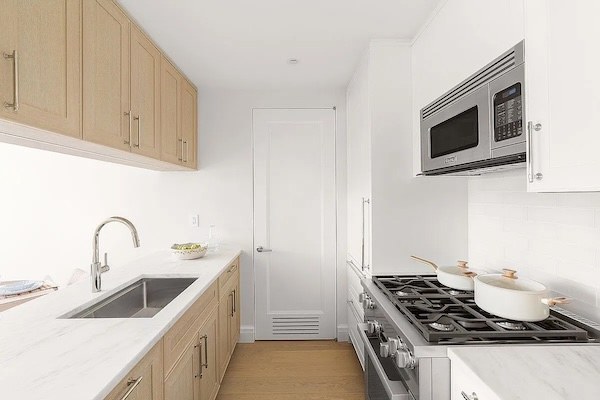
A co-op buyer owns shares in a corporation, not a piece of real property, and the building's roof, facade, boilers and risers belong to every shareholder together. That changes what a home inspection can tell you. This guide explains what an apartment inspector covers, what the inspector misses, when skipping one is riskier and which building records answer the questions an inspector cannot. The worked example is a $1.2 million Yorkville one-bedroom, two-bath apartment like the one pictured. We do not know that building's rules, finances or whether it is a co-op or a condo, so the figures are an illustration. Figures are as of November 9, 2026.
What does a home inspector check in a Manhattan apartment?
An apartment inspection covers the inside of the unit. Milton Coste, in an October 29, 2026 guide, lists outlets, appliances, the HVAC units serving the apartment, water pressure, plumbing fixtures, windows, doors and visible signs of leaks or pests. StreetEasy adds that the inspector assesses electrical, heating and cooling systems for failure risk and checks walls, ceilings and floors for water damage. In a kitchen like the one pictured, that means running the faucet, testing the range and the microwave and looking under the sink for old leaks. Brick Underground's list for buyers is the same: test outlets, appliances and water pressure, and look for leak evidence on floors, walls, ceilings, under sinks and in closets.
A visit takes about 45 minutes to 2 hours and the report arrives 24 to 48 hours later, per Milton Coste. StreetEasy gives an example of an oven that could not reach 350 degrees, which let the buyer negotiate money for a replacement.
What do inspectors miss?
The shared systems. In most buildings the corporation or association controls them, so inspectors usually cannot reach the roof, facade, mechanical rooms, elevators or risers in common walls, per Milton Coste. Hauseit says there is no guarantee a large building will let an inspector into the roof or the boiler room. Hauseit also says that in a well-maintained large building an inspector can usually find little beyond what you can see yourself.
Those shared systems carry the large bills. A roof, a facade or a boiler is paid for by shareholders, either through maintenance or through an assessment. An inspection of your unit cannot tell you whether that bill is coming.
Do Manhattan buyers actually get inspections?
Most do not. Milton Coste cites a Corcoran broker's estimate, via Brick Underground, that roughly 15% of New York City co-op and condo buyers pay for a formal inspection. Attorney Dean Roberts of Norris McLaughlin told Brick Underground that in most cases a co-op inspection is neither typical nor cost effective. Broker Bianca D'Alessio of Nest Seekers said skipping one does not present a major risk if the buyer does thorough due diligence and finds the information elsewhere. StreetEasy quotes broker Ivana Tagliamonte: inspections are not commonplace for co-ops and condos.
When is skipping the inspection riskier?
The sources agree on a short list of cases where an inspection earns its fee:
- Top-floor and penthouse units. Roof leaks reach you first, per Milton Coste, Hauseit and Brick Underground.
- Garden-level, ground-floor and basement units. Hauseit lists flooding, drainage, vermin and moisture. Milton Coste adds sewer backups.
- Prewar apartments with original wiring or plumbing. Milton Coste flags in-unit systems from that era.
- Private terraces and roof decks. Milton Coste lists terraces, and Hauseit says an attorney, not the inspector, assesses who pays for repairs.
- Combined or gut-renovated units and estate-condition apartments. Milton Coste names combined and gut-renovated units. Brick Underground says an inspection can make sense for an estate-condition co-op that sat vacant.
- Small buildings. Fewer owners share each repair. The sources draw the line differently: six units or fewer per Brick Underground, 10 or fewer per Hauseit, and three or four units per Milton Coste.
What should you check instead?
Move the money to the building. Roberts and Milton Coste point to the same records:
- Financial statements and budget. Two years of audited statements and the current budget show reserve funding and any surplus or deficit. Our financial statements guide covers the 10 numbers to check.
- The reserve. Roberts says a well-run building keeps at least three months of carrying costs in reserve, and Brick Underground reports the other common test as a quarter of annual operating costs.
- Board minutes. Twelve months of minutes show capital projects early, per Milton Coste. Roberts says a low reserve with no planned or recent capital projects usually means the board is not spending enough on maintenance.
- The latest engineer's report. Roberts often asks the managing agent for it.
- Alteration history. It confirms renovations had board approval and met code, per Milton Coste. See our alteration agreement guide.
- Facade and roof status. Our Local Law 11 guide explains the facade cycle and how assessments reach buyers.
- Gas piping. The Department of Buildings requires a licensed master plumber to inspect a building's gas piping at least once every four years, and the owner files a certification. DOB's schedule puts Community District 8, the Upper East Side, in the cycle due December 31, 2026. Ask the managing agent whether the building has filed and whether anything needed correction. An apartment inspector does not certify the building's piping. DOB's public portal shows the district for any address.
Your attorney runs this review. Roberts and D'Alessio both say an attorney's due diligence, including board minutes and the managing agent questionnaire, gives the most complete view of the building's structure. A licensed engineer's opinion can add to it if the renovation history raises concerns, per Milton Coste.
What does it cost? A worked example at $1.2 million
Assume a $1.2 million Yorkville one-bedroom, two-bath apartment with 20% down. Because the price is over $1 million, the buyer pays the 1% mansion tax. Our cost to buy guide covers the rest of the closing costs. The inspection is a small line next to them.
| Item | Amount |
|---|---|
| Price | $1,200,000 |
| Down payment (20%) | $240,000 |
| Loan amount | $960,000 |
| Mansion tax (1% at $1 million or more) | $12,000 |
| Apartment inspection, Milton Coste range | $450 to $1,000 |
| Apartment inspection at the $600 to $700 average | about 0.05% of the price |
The inspection is cheap. The question is what it can see. Take a hypothetical: the board approves a $3 million roof and facade project funded by an assessment, and your apartment holds 1.2% of the shares. Your share is $36,000, billed on top of maintenance. That is arithmetic, not a forecast for any building. An inspector inside your unit will not see that bill coming. The financial statements, the board minutes and the engineer's report will.
Inspection shown at $650, the midpoint of Milton Coste's $600 to $700 average. The assessment is a hypothetical: a $3 million project and a 1.2% share. Illustration, not a quote. Data as of November 9, 2026.
When do you inspect, and what if it finds a problem?
Inspect before you sign. StreetEasy says the inspection typically happens between offer acceptance and contract signing. Milton Coste says inspection contingencies are rare in New York City apartment contracts, since sales are typically as-is, and that findings work as information, not a guaranteed second round of negotiation. Brick Underground reports that most co-op contracts require systems and appliances to be delivered in working order unless listed as as-is, and that the buyer gets a final walk-through 48 hours before closing. Our offer guide covers the contract period and the 10% deposit.
What about townhouses?
Different answer. A townhouse has no board, and the owner carries every system. Milton Coste calls the inspection not optional and puts it at up to $2,500 for a 3,000 to 5,000 square foot building, plus $300 to $500 for a sewer scope. He gives $85,000 to $250,000 or more for a brownstone facade restoration and $15,000 to $40,000 for a roof replacement. Our Carnegie Hill townhouse guide covers the taxes, financing and landmark rules.
How do you start?
Tell us your budget and the building types you are considering. We match you with a licensed New York agent who works Yorkville, Carnegie Hill or Lenox Hill, plus an attorney who reviews the building records and an inspector for the cases above. Out-of-state buyers should read our out-of-state guide first. Submit a private inquiry below.
General information only, not legal, tax, engineering or financial advice. Laws, rates and costs change and each building and contract differs. The photo shows a Yorkville one-bedroom, two-bath apartment listed at $1.2 million; we have not verified its building details, including whether it is a co-op or a condo, and listings can change or sell. Some sources are older, so confirm current terms. Inspection costs come from one 2026 guide and one StreetEasy article and vary by apartment. The assessment example is a hypothetical, not a forecast. Peter is licensed in Connecticut and does not represent buyers in New York. Confirm every step with your New York attorney and lender.
Frequently asked questions
Do I need a home inspection to buy a co-op in Manhattan?
Usually not. Attorney Dean Roberts told Brick Underground that a co-op inspection is neither typical nor cost effective in most cases. Milton Coste cites a Corcoran broker's estimate that about 15% of New York City co-op and condo buyers pay for one. Buy an inspection for a top-floor, garden-level or estate-condition apartment, or for a small building. Otherwise put the money into your attorney's review of the building.
How much does a Manhattan apartment inspection cost?
Milton Coste puts an apartment inspection at $450 to $1,000, averaging $600 to $700, with a visit of about 45 minutes to 2 hours and a report in 24 to 48 hours. StreetEasy puts the average near $500 for a one-bedroom. Cost rises with the size and age of the apartment and whether it has its own HVAC. A townhouse costs more, up to $2,500 for 3,000 to 5,000 square feet.
What does an apartment inspector check, and what do they miss?
Inside the unit, an inspector checks outlets, appliances, the HVAC units serving the apartment, water pressure, fixtures, windows, doors and visible signs of leaks or pests, per Milton Coste. The corporation or association controls shared systems, so inspectors usually cannot reach the roof, facade, mechanical rooms, elevators or risers in common walls. Hauseit adds that there is no guarantee a large building gives the inspector access.
Can I renegotiate the price or back out if the inspection finds a problem?
Plan on neither. Milton Coste says inspection contingencies are rare in New York City apartment contracts because sales are typically as-is, and that findings are information, not a guaranteed second round of negotiation. StreetEasy says the inspection usually happens between offer acceptance and contract signing. Inspect before you sign and send the 10% deposit. See also: How to Make an Offer on an Upper East Side Apartment.
What should I review instead of an inspection?
Read two years of audited financial statements and the current budget, 12 months of board minutes and the latest engineer's report, and check the alteration history and the reserve. Roberts says a low reserve and no planned or recent capital projects usually mean the board is not spending enough on maintenance. Our financial statements guide walks through the numbers. See also: How to Read a Co-op's Financial Statements Before You Offer.
How do I find out whether a building faces a big facade or roof bill?
Ask the managing agent for the facade inspection report, the latest engineer's report and the board's capital plan, and read the minutes for approved projects. A project funded by an assessment lands on shareholders in proportion to their shares. Our Local Law 11 guide explains the facade inspection cycle and how assessments reach buyers. See also: Local Law 11 Facade Inspections and Assessments on the Upper East Side.
Sources
- Milton Coste: NYC home inspection guide for co-ops, condos and townhouses (October 29, 2026)
- Brick Underground: When you're buying a NYC co-op, is it risky to skip the home inspection? (January 17, 2023)
- Hauseit: Should you get an inspection before buying a co-op in NYC? (October 10, 2018, modified October 22, 2019)
- StreetEasy: Do you really need a home inspection? (April 7, 2021, modified January 15, 2026)
- NYC Department of Buildings: Periodic gas piping system inspections
- NYC Department of Buildings: Local Law 152 inspection schedule by community district
Buying in Manhattan?
Peter is a Connecticut-licensed REALTOR® who introduces buyers to licensed New York agents. Tell him your budget and building type and he will match you with the right one.
October 30, 2026
Buying an Upper East Side Apartment for Your Child: Parent Guarantors, Gifted Down Payments and What Co-op Boards Allow in 2026
How a gift, a guarantor and a co-purchase work, what co-op boards allow, the gift tax paperwork, and the cash and income needed on a $925,000 Yorkville one-bedroom.
Read →October 29, 2026
How to Make an Offer on an Upper East Side Apartment: Bidding, the Contract, the 10% Deposit and the New 45-Day Co-op Board Clock in 2026
What an offer includes, how negotiation and the contract work, the 10% deposit, contingencies and the new 45-day co-op board clock, with a worked example on a $549,000 Yorkville one-bedroom.
Read →October 2026
Yorkville vs. Carnegie Hill: Which Upper East Side Neighborhood Fits?
Two very different ways to live on the Upper East Side, and the questions that decide between them.
Read →October 2026
Co-op or Condo on the Upper East Side: How to Choose
What you actually own, how approval and financing differ, and which buyers each structure suits.
Read →October 2026
What Goes Into a Co-op Board Package
The documents co-op boards ask for, how the review works, and how to prepare before you make an offer.
Read →October 3, 2026
How Much Does It Cost to Buy an Apartment on the Upper East Side in 2026? Price, Closing Costs, Taxes and Monthly Fees
Upper East Side prices, buyer closing costs, the mansion tax, monthly charges and the new pied-à-terre surcharge for co-op and condo purchases, with 2026 figures.
Read →October 4, 2026
Manhattan Sales Rise as Inventory Shrinks: What the Third Quarter 2026 Numbers Mean for Upper East Side Buyers
Manhattan closed sales rose 8% and listings fell 10.7% in the third quarter of 2026 while the median price held at a record $1.25 million. What it means for Upper East Side buyers.
Read →October 5, 2026
Rent vs. Buy on the Upper East Side in 2026: When Does Owning Beat Renting?
A $4,500 rent costs $54,000 a year. See what ten years of renting and owning cost on the Upper East Side and when owning breaks even at 2026 rents and mortgage rates.
Read →October 6, 2026
Will Upper East Side Prices Fall to Offset 7% Mortgage Rates? What Buyers and Sellers Should Do
Prices would have to fall 41% to offset a 7.28% mortgage rate against the 2021 low. Practical moves for Upper East Side buyers and sellers in the 2026 market.
Read →October 7, 2026
How to Buy an Apartment on the Upper East Side as an Out-of-State Buyer: A Step-by-Step Guide for 2026
The steps, deposit, timeline and costs to buy an Upper East Side apartment if you live outside New York, from preapproval and attorney to board approval and closing.
Read →October 8, 2026
Buying a Pied-à-Terre on the Upper East Side in 2026: A Checklist to Run Before You Make an Offer
Co-op rules, the new NYC pied-à-terre surcharge, New York tax residency, second-home financing and rental limits: eight checks to run before you buy a part-time apartment on the Upper East Side.
Read →October 9, 2026
Upper East Side Maintenance, Common Charges and Hidden Fees in 2026: What You Pay Every Month After You Buy
What co-op maintenance and condo common charges cover, what they leave out, typical Upper East Side ranges, and how to spot special assessments before you buy.
Read →October 13, 2026
How to Read a Co-op's Financial Statements Before You Offer: The 10 Numbers Upper East Side Buyers Should Check
Reserves, underlying mortgage, arrears, sponsor-owned units, assessments and audit notes: what each number means, what to look for and the red flags in a co-op building's finances.
Read →October 14, 2026
Manhattan Rents Are Up 7.7% While Rental Listings Shrink: Why Some Upper East Side Renters Should Run the Numbers on Buying
Manhattan median rent is $4,900 and rental listings have fallen 15 months in a row. What the September 2026 rental report shows, what it does not, and when buying is worth a serious look.
Read →October 15, 2026
How Much Down Do You Need for an Upper East Side Co-op? Down Payment, Debt-to-Income and Cash Reserve Rules Explained
Most Upper East Side co-op boards look at three numbers: your down payment, your debt-to-income ratio and the cash you keep after closing. Typical ranges, what counts, and a worked example on a $329,000 one-bedroom.
Read →October 16, 2026
How Much Will You Net Selling an Upper East Side Co-op? Transfer Taxes, Flip Tax, Commission and Closing Costs Explained
What a $1,595,000 Upper East Side sale leaves in your pocket: transfer taxes, flip tax, commission, attorney and building fees, a worked net proceeds table and the tax on your gain.
Read →October 18, 2026
Why Upper East Side Apartments Are Priced at $999,000: How the $1 Million Mansion Tax Line Changes Your Offer
A $999,000 asking price sits $1,000 under the $1 million mansion tax line. What a $1,000,000 bid really costs, the cash needed on a $999,000 two-bedroom, and how buyers and sellers should offer and price.
Read →October 19, 2026
What Happens at an Upper East Side Co-op Board Interview? Questions, Timeline and How to Prepare in 2026
What a co-op board interview is, the questions boards ask, how long approval takes, what a board can and cannot legally do, and a worked number check on a $525,000 one-bedroom.
Read →October 20, 2026
Local Law 11 Façade Inspections and Special Assessments: What Upper East Side Co-op Buyers Should Check Before They Offer in 2026
What NYC's façade inspection law means for a co-op buyer: Safe, SWARMP and Unsafe reports, sidewalk shed rules, how a special assessment could hit your share, and what to ask before you offer.
Read →October 21, 2026
Can You Renovate an Upper East Side Co-op? Alteration Agreements, Board Approval, Costs and Timelines in 2026
What an alteration agreement is, what a board needs before you renovate, the fees and timeline before work starts, what renovation costs per square foot, and what to check before you offer.
Read →October 22, 2026
What Happens at a Co-op Closing in Manhattan? Documents, Cash Due, Timeline and a Closing-Day Checklist for 2026
The documents, cash due, timeline and closing-day checklist for a Manhattan co-op purchase, with a worked example on a $675,000 Yorkville one-bedroom.
Read →October 23, 2026
Buying a $1.375 Million Upper East Side Co-op: Is It a Jumbo Loan? Down Payment, Mansion Tax and Cash Needed in 2026
Whether a $1.375 million co-op loan is a jumbo, plus the down payment, $13,750 mansion tax, cash to close and monthly cost, with a worked example on a Yorkville two-bedroom.
Read →October 25, 2026
Buying a Newly Renovated Studio on the Upper East Side: What to Check on a $319,000 Yorkville Co-op in 2026
What a "newly renovated" studio co-op does and does not tell you, the documents to request, monthly cost, cash to close and sublet rules, with a worked example on a $319,000 Yorkville studio.
Read →October 28, 2026
Buying a Ground-Lease Co-op in Lenox Hill: Lease Expiration, Rent Resets, Financing and What to Ask Before You Offer in 2026
How a ground-lease co-op works, why the rent reset and lease expiration matter, a real Lenox Hill listing, and cash to close at $1.195 million, with the questions to ask before you offer.
Read →October 12, 2026
How to Buy an Apartment Under $500,000 on the Upper East Side in 2026: What You Get, What to Check and the Catches
Three real Upper East Side listings under $500,000, what they cost each month, how much cash you need, first-time buyer loan programs and the co-op catches to check before you offer.
Read →